
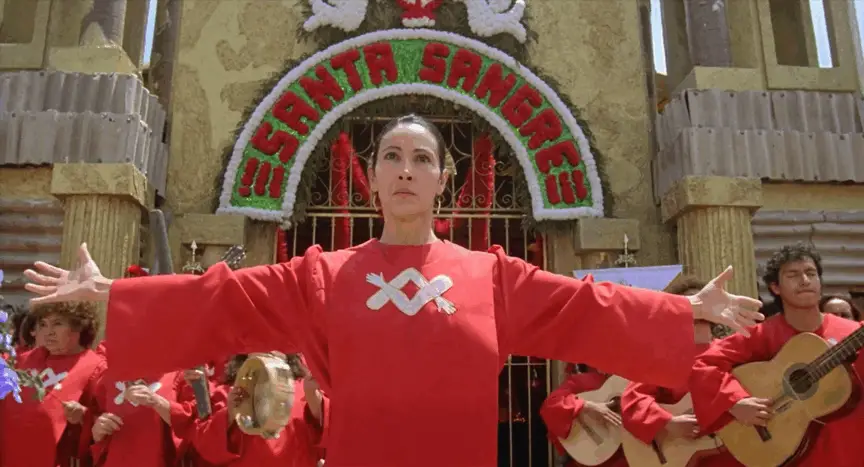
Santa Sangre is Alejandro Jodorowsky’s other, OTHER genre classic!
Alejandro Jodorowsky has three undisputed masterpieces: El Topo, The Holy Mountain and this film. What makes Santa Sangre such a remarkable film is how it encompasses and denies conventional labels at the same time. It’s a horror movie, through and through, replete with references to any number of Universal Monsters classics and such pioneering cinematic shockers as Tod Browning’s Freaks. But it’s also an ANTI-horror movie in some ways, at least in terms of what “horror” meant in a broader pop cultural context circa 1989.
Santa Sangre is definitely an outlier in a year that overdosed on sequels. Compare this to Elm Street 5, Halloween 5 and Friday the 13th Part EIGHT and it becomes evident just how against-the-grain this film truly is. I kinda get the feeling that it was rated NC-17 simply because the uptight prudes at the MPAA couldn’t understand it. A movie filled with sex and violence is one thing, but an INTELLIGENT movie filled with sex and violence (along with a lot of subtext about machismo and religious indoctrination) is just too much for those jerks. It outsmarted them, and the penalty Santa Sangre had to incur was the motion picture equivalent of the Scarlet Letter … a big, wet tongue-filled death kiss that all but sealed its cinematic failure at the box office for sheer ideological reasons.
The “categories” box on the film’s Wikipedia entry pretty much TELLS you how loaded the film is, subtextually. Films about dysfunctional families, films about violence against women, Mexican religious horror films, 1989 slasher films, films about sideshow performers, Italian nonlinear narrative films … there is a LOT going on in this movie. But it’s never a mess, or confusing, or just excess for the sake of excess. There’s a real story here and it’s one of the best psychological thrillers from a decade that gave us a lot of great psychological thrillers. And as bizarre as its premise may sound, it’s actually WAY more accessible than you’d think.
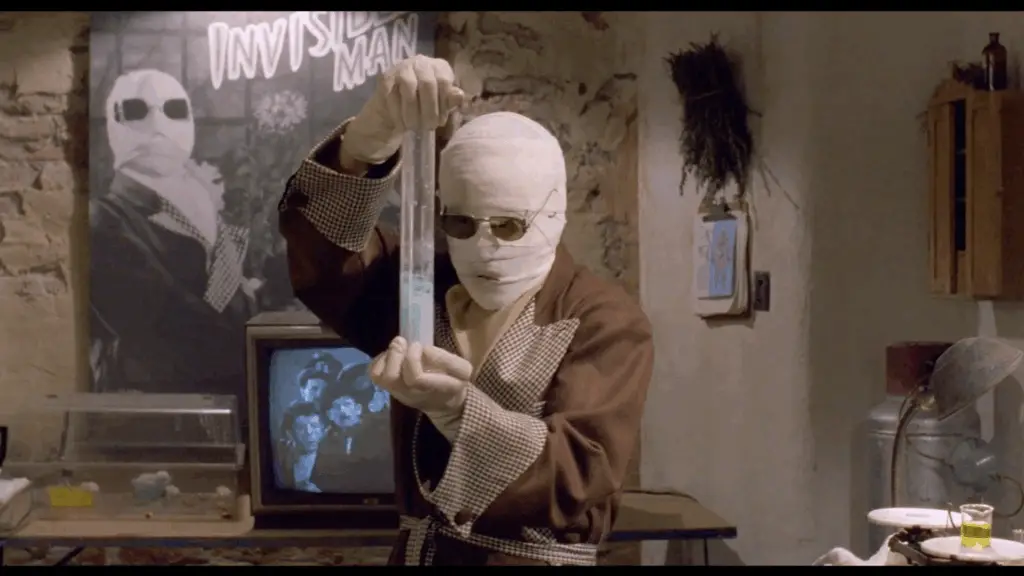

It’s a film, first and foremost, about families. And in this case, it’s a Mexican circus family where the dad is a morbidly obese adulterer and the mother is a borderline schizophrenic cult leader who REALLY doesn’t like finding out her hubby is cheating on her with the tattooed knife-catching lady. Long story short, we get a GREAT acid to the groin scene, and from there this movie gets REALLY bonkers.
So the main character Fenix (played by the director’s son, Axel Jodorowsky) is a little screwed up from all of the things he experienced as a kid. To give you an idea, watching an elephant get dismembered in a landfill is one of the LEAST traumatic moments of his youth. So he grows up and winds up in an insane asylum, where he thinks he’s an eagle, but after doing cocaine and cavorting with some prostitutes, he comes to his senses and realizes his TRUE goal in life … to murder as many women who kinda-sorta remind him of the side-piece that broke up his parents’ marriage.
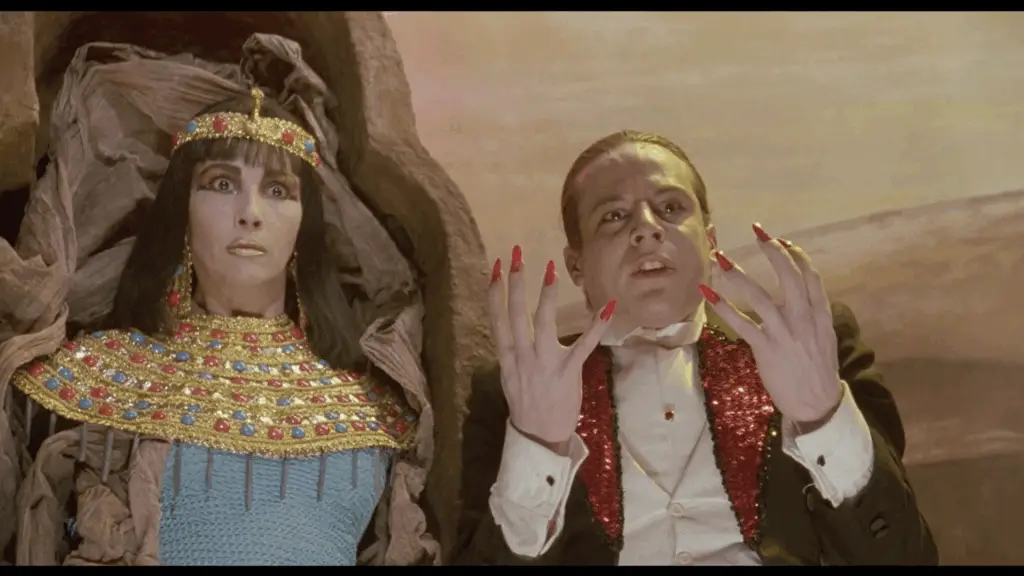
Sure, it all seems like mundane, by the numbers stuff, but we’re not done. You see, apparently Fenix’s mom SURVIVED getting her arms lopped off when he was a kid and they reunite for this weird tandem knife-throwing routine with a LOT of unsavory faux-incest overtones in the mix. So it’s sort of a Jason/Mrs. Voorhees dynamic going on … only with a major subplot about the psycho killer of the movie abducting a musclebound lucha libre wrestler with synthetic breasts and butchering her in an homage to The Mummy, of all possible things.
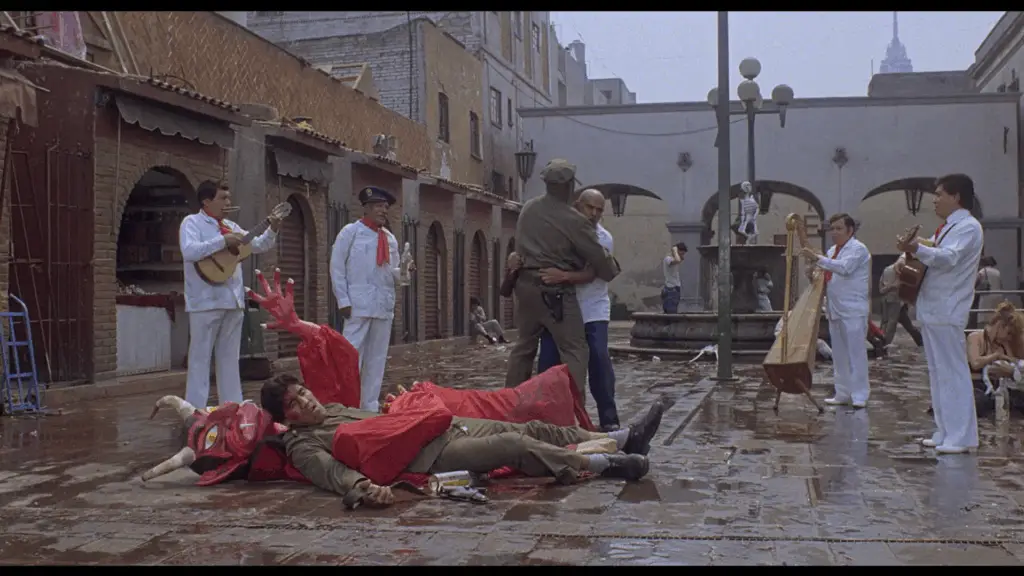
Of course, kinda’ the undergirding bass line of the movie is whether or not Fenix’s mom — named “Concha,” which is a euphemism for something the Wicked Horror higher-ups REALLY don’t want me talking about on this website — is actually alive, a metaphor, an illusion inside his disturbed head or something even WORSE. The ending is a bit predictable, but holy hell, is it EFFECTIVE. It seems like Fenix has been “cured” by the power of love, until you realize he’s killed god knows how many innocent women in some sort of indecipherable, Freudian quest for childhood vengeance. For my money, the very best scene in the film — and one of the best scenes from ANY 1980s horror movie — is when Fenix visits a graveyard haunted by the chalk-white zombies of the scores of women he slayed. It’s unnerving, it’s haunting and in an absolutely bizarre, irrational way, it’s also kind of beautiful. This is arthouse horror done RIGHT, and virtually every scene in the film is a visual tour de force with vibrant colors, exquisite cinematography and characters you can’t take your eyes off of (even though in some cases, you really wish you could.)
Jodorowsky deserves a TON of credit for making this movie work, but lost in the shuffle a bit is cinematographer Daniele Nannuzzi. Simply put, without his handiwork this movie WOULD not be the all-time cult classic we know and love today. He’s easily one of the most underrated directors of photography in movie history and this film is certainly his magnum opus. The scene in the “blasphemous” chapel … where Concha’s adherents worship a pool of red paint amidst crude etchings of a dismembered woman … is right up there with ANYTHING you’d see Dario Argento or Lucio Fulci’s best work. As far as pure aesthetics go, this is one of the most awe-inspiring films of the 1980s. And I’m not limiting that to just horror movies, either.
Santa Sangre is STILL a controversial movie nearly 40 years later. It’s too artsy to satisfy populist slashers fans and it’s too bloody and crude to appeal to the avant-garde set. But there’s a nice middle ground audience that understands and LOVES what this movie is about. It’s a movie about trauma (long before that was the default setting for every horror movie ever) and you could rightly state that the entire thing is basically a metaphor for toxic masculinity. Imagine Maniac helmed by Luis Bunuel and you kinda get the gist of Santa Sangre.
If you’ve never seen it before you OWE it to yourself to check out Santa Sangre as soon as possible. It’s not the most orthodox pick for a Halloween evening screening, but it definitely fits the mood (and failing that, hey, Day of the Dead IS one day later, isn’t it?) And if it’s been a while since you last saw Santa Sangre, it’s DEFINITELY worth revisiting. It’s the thinking person’s psychosexual slasher movie — and, in a lot of ways, the perfect capstone for a decade oft-considered the golden era of degenerate horror cinema.
